Category Archives: Everything

The Omnivore’s Dilemma

The Omnivore’s Dilemma is the classic modern food and farming book, so I felt obligated to read it and I’m slightly embarrassed to say that I just finished it. In this book, Michael Pollan attempts to answer the question that we face as we are presented with more and more options at the grocery store: what should we eat? Meat or plants? Conventionally grown foods or local-organic ones? He investigates and travels to find the answers to these and many other questions.

Here is a video I would recommend that introduces the organization and ideas of the book. At the beginning of the book, Pollan hit me with so much information that I remember thinking, “Each one of these paragraphs could almost be expanded into a book of its own.” Pollan’s book and especially its first section will definitely show you and tell you things that you didn’t know were true. As the book progresses, it moves further from conventional industrial agriculture towards alternative ways of growing food and finally towards finding your own food. The book becomes more cultural and spiritual and less factual, which is a really interesting journey I think. Pollan becomes more and more connected to his diet as he starts to take initiative and learn more about his food. The book contains valuable wisdom and insights into food and our food system. Pollan cites many authorities that range from J.I. Rodale who coined the term “organic” to modern ethicist Peter Singer. It is clear that Pollan has done some reading and research.

Though Pollan never does give a simple answer to “What should we eat?,” his opinions become pretty clear. While I do highly recommend the book for its evaluation, analysis, and comparison of different food-production models, I warn the reader to be aware of Pollan’s bias. It took me a while to see, but I understood it more after reading some reviews of the book. At times Pollan’s opinions bring him to present ideas and information in a misleading or one-sided way.

For example, at the beginning of the book, as Pollan tries to follow a steer on its journey birth to slaughter to burger, he discusses the corn and grain based diet of beef cows towards the end of their lives. Pollan says that this diet “rarely lasts more than 150 days,” after mentioning earlier that the calf spent its first six months of life on pasture. You wouldn’t know it from what Pollan says, but 30-40% of American beef is 100% grass-fed during the cows’ entire lives. And in all actuality, there are many ranchers who feed their cattle on pasture for much longer than 6 months, often 18 months or more, before sending them off to the feedlot. And depending on who you ask or what feed lot you are at, the number of days a beef steer spends on a feedlot is usually closer to 100 days.

I am not saying that I agree with all the practices of conventional beef production, I am just defending the facts. Pollan never lies, but he does leave some things out or chooses to focus on the worst of the industry. Though Pollan has many great and insightful things to say, my one problem is that at times he presents the issues in a way that seems kind of black and white, when things are in fact much more gray. At times he seems to blow things out of proportion, state his opinions like they are facts, or just go for shock value. I suppose that it is hard to avoid some degree of black-and-whiteness when writing from a very opinionated point of view, but it is nice to be aware of the point of view when reading the book. Now that I’ve said all of this, go out, buy the book, learn something new about our food system, and form your own opinion on it! And then read some other books on the food industry and compare their ideas to Pollan’s because The Omnivore’s Dilemma isn’t the only one out their.

-Simon
Growing Power

Growing Power is an urban farm and organization started by Will Allen in Milwaukee, Wisconsin. Growing Power produces a giant range of foods- all types of produce along with fish (tilapia or yellow perch), eggs, goat’s milk, duck, and honey. In total, the farm grows 150 crops and produces 1 million pounds of food annually on just 3 acres. And it’s in the middle of a city.

Here is the Growing Power website and two short videos about the organization: websitevideo #1,  video #2,

Growing Power employs many creative methods to be able to produce so much food in such little space. In the greenhouses where the farm grows its veggies, there are many different layers  and shelves of plants stacked to maximize the space. Growing Power also combines hydroponics (growing plants in nutrient solution, without soil) with aquaculture (fish farming) in an arrangement called Aquaponics. This system pumps water from the fish tank to the plants growing above. In this water is fish waste- which contains many nutrients like Nitrogen that fertilize the plants. As the plants absorb these nutrients and filter the waste out in the process, the newly cleaned water  flows back down to the fish who add their waste to it, and the cycle continues. Instead of having an output of waste and an input of chemical fertilizer, Growing Power imitates a healthy natural system to create a waste-free cycle. To warm the water for these fish, the farm utilizes solar energy rather than natural gas.

Instead of using chemical pesticides, Growing Power gets rid of its pests with beneficial insects like ladybugs, hand picking weeds or spraying compost tea on the leaves. Compost tea is basically liquefied compost, made by soaking compost in water. Compost tea’s pesticidal properties come from the beneficial bacteria and fungi carried in it, which compete with and get rid of harmful bacteria or fungi. Also, the soil is key. Growing crops in nutrient-rich compost gives the plants all they need to stay healthy, strong, and less vulnerable to pests.

Growing Power also farms year round even though it snows in Milwaukee and is below freezing for three months of the year. The farm is able to grow in the winter by using compost as a heat source. In the corners of the greenhouses are piles of composting organic matter. The many different microorganisms in the compost give off heat as they carry out their many processes to decompose the food waste into soil. (The center of a compost pile can be more than 150ºF.) This produces high quality soil and allows the farm to grow food in the otherwise impossible conditions of such cold weather. Growing Power collects waste from the local newspaper, brewery, coffe shop, and a few markets- a total of 10 million pounds of waste per year. This means 10 millions pounds of waste that aren’t going into landfills but instead helping to produce a variety of foods.

While Growing Power produces food in amazing ways, a huge part of their goal is also to build community. Because the company is not working for profit, it can put a lot of time and energy into outreach and education without worrying too much about money. The farm offers free daily tours that help people understand how the farm works, but also how to start their own garden. The organization offers tons of volunteer or internship opportunities  which get people off the street, interested and involved in producing their food. Growing Power also leads workshops and many other educational programs to connect with youth and adults of the community. Through their market baskets, which include produce from their farm and a cooperative of other small family farms, Growing Power offers healthy and extremely affordable produce to low-income families who would otherwise be eating highly processed and unhealthy food. Growing Power formed the Rainbow Farmers Cooperative to support these small farms, offering them a steady market for their produce as well as training and help with grants, transportation, and publicity. The organization also donates compost, seed, and other products which help to get these farms started and sustained.

In Milwaukee and now with a side project in Chicago, Growing Power helps connect sustainably grown, healthy food with community-members. But even outside these two cities, the organization’s ideas and influence spread through the Rainbow Farmers Cooperative and anyone who is inspired by their accomplishments and their story. If you are interested in learning more, check out Will Allen’s book, The Good Food Revolution, which I’ve just started.

-Simon

Eating Oil, Eating Sunshine

Here is a fascinating presentation by Michael Pollan, journalist and professor at UC Berkeley. I know that the video is pretty long, but Pollan’s presentation doesn’t start until 23 minutes in and I really encourage you to watch the whole thing, even if it’s in chunks of 10 minutes at a time. Pollan gives an in-depth history of the food system in the last 70 or so years. I think this video is important to watch if you’ve ever wondered “How did we get to this point, when our agricultural system is so wasteful, pollutive, and unsustainable?” or “When did we go from small, self-supporting family farms to the huge, standardized, pesticide-ridden farms so common today?” Looking back helps explain our current situation by showing us how we got here. In investigating the choices and ideas that led us to our current food system, we have to ask: “Do these ideas still hold up and work well? Or did they ever?”

In Examining our past and understanding how we came to our current situation, we can think about how we want to move forward. We may praise pre-WWII agriculture because it was more environmentally efficient, taking its energy from the sun rather than petroleum. But does is this the exact way we want to proceed? We have to decide if it will work to revert to these old ways and if that way of farming makes sense for our modern times. Pre-WWII, when people were growing their own food, the diet was less diverse and the life expectancy shorter. My grandpa told me once that never even saw fruits like kiwis or banans for most of his life because everything that people ate was grown close to home. Nowadays, many people probably aren’t willing to give up the exotic fruits grown in Hawaii or the peppers from Mexico that they can get year round because of the warmer climate. How can we apply the pre-WWII model to our  situation and adapt it, tweak it to fit the current and predicted future conditions? Maybe it will work in some places, for some people, but we’ll need to incorporate more modern technology and knowledge. We can compare new methods in farming to the old ones and ask if it meets the same standards, even if the new techniques might seem completely different from the old ones. Maybe we just have to find the timeless core idea of that old farming, its strongest central value, and preserve that in all of our agricultural endeavors.

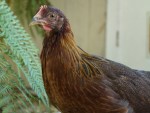
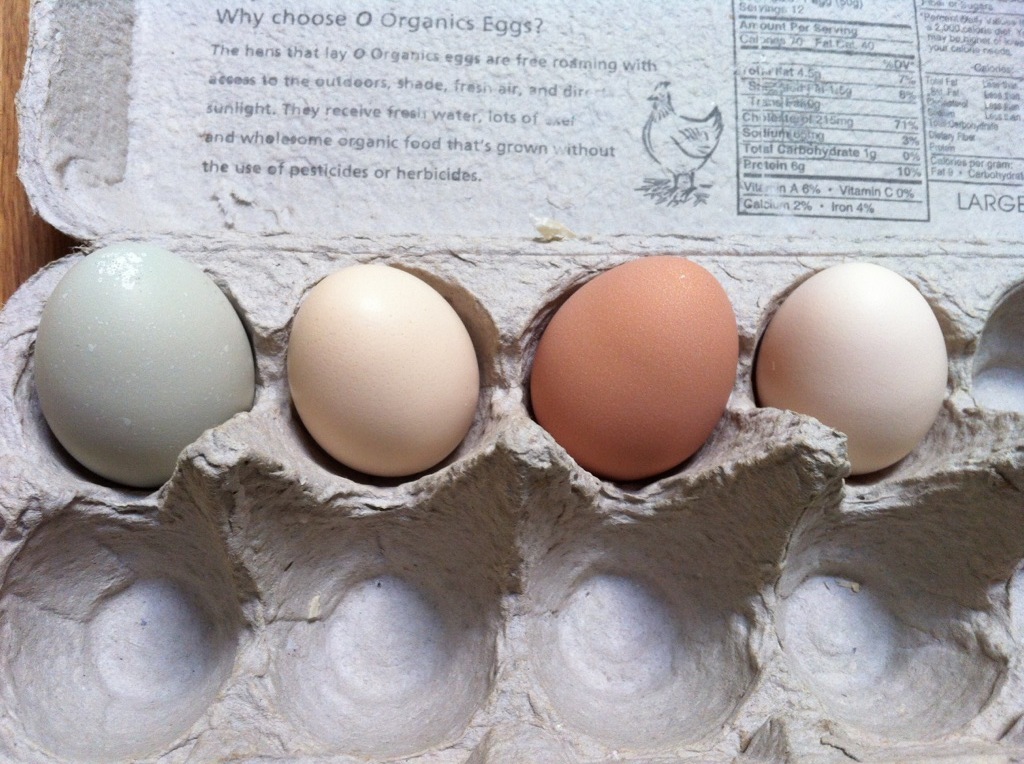
On a different note, our chickens have just started laying! They are so fresh and delicious. Right now, just three are laying so we’re getting light green, brown, and cream-colored eggs. But soon, as they all start laying, we’ll get white eggs and dark chocolate brown eggs too. It’s pretty exciting to go out and see the eggs and think about what we’ve given the hens so that they’ll give us their eggs in return.

IMG_3124

-Simon

Tomatoland by Barry Estabrook

Often, when buying a fruit or vegetable and thinking about the farm that it has come from, I picture nice rows of lush plants and ask myself “what is the worst thing that could’ve gone into produce this vegetable?” I think of a few things: pesticides or chemical fertilizers, but this book showed me how complicated and multifaceted the process of producing that vegetable really is.

In Tomatoland, Barry Estabrook explores and documents everything that goes into producing a tomato, meeting people who are involved at every step in the process. The way that most tomatoes are grown is very different than what we might imagine or how we grow them in our gardens. This process likewise yields a very different tomato than a hom-grown one. Many tomatoes are picked when green and sprayed with ethylene gas to ripen them. The plant naturally produces ethylene to regulate the fruit’s ripening, but picking the tomatoes while they are harder and less ripe means less damage and bruising during transportation. The flavor of a gassed tomato, however, will never match that of a tomato allowed to ripen on the vine. Workers are supposed to only pick “mature green” tomatoes which are about to turn red and are almost ripe, but it is hard to distinguish between a “mature green” and a less mature tomato which has even less flavor. Modern industrial agriculture is concerned only with the yield of a tomato plant, the tomato’s size and shape. The modern tomato has lost all its flavor in the name of uniformity and quantity.

Most tomatoes are grown in Florida, one of the only places in the country warm enough to support the crop in the winter. The problem is that Florida’s hot and humid weather supports many pests and pathogens, around 30 insect species and 30 more diseases that can affect a tomato’s growth. This means that many potent and toxic pesticides must be used to keep the plants healthy. Many of these pesticides are deadly even with brief exposure and cause health problems for workers. Another problem with growing tomatoes in Florida is that there is only sand to grow them in, which has very little nutrients for the plants. In order to support the plant, growers must add high amounts of chemical fertilizer, which pollutes groundwater and nearby lakes. All of this environmental harm comes from forcing the tomato to grow in unideal, unnatural conditions. We have to learn to farm in harmony with the seasons rather than trying to fight them. If we don’t wait until summer to enjoy a tomato, we are supporting this pollutive and unsustainable process.

Estabrook details the issues with policy and law, workers’ rights, immigration, and all the different corporations that are involved in modern tomato farming. Throughout the book, Estabrook looks at the people who are working to change modern tomato farming, whether it’s a lawyer who represents mistreated workers, a farmer who grows tomatoes organically on a large scale, or a scientist working to create a new tomato variety with more taste. Much of the book is centered on the small town of Immokalee in southern Florida. However, every part of this close-up look––the battles between small NGOs and big corporations, the trade-off between quality and quantity or economic efficiency and sustainability––can be extrapolated to consider modern industrial agriculture as a whole.

Needless to say, my old view of the simple green rows of vegetables doesn’t hold up after considering everything else that goes into the process. After reading this book, a tomato doesn’t seem so innocent. It has an elaborate background and a long history. The farming that went into it has complicated economic, social, and environmental consequences. As food writer Ruth Reichl said, “If you have ever eaten a tomato––or ever plan to––you must read Tomatoland. It will change the way you think about America’s most popular ‘vegetable.’ More importantly, it will give you new insight into the way America farms.”

Rice as an Indicator Species

I was reading this Grist article on the arsenic content of rice and found that it had a lot to say beyond just the levels of this toxin in our rice. To me, this article shows the cyclical nature of all our actions in agriculture, and toward the environment in general. To quote the article directly, the new study “illustrates what a long shadow industrial farming practices can cast over the entire food system — and the way some chemicals can cycle through our food and water, for literally generations… even rice grown organically is impacted because of what you might call the legacy of the soil.” There is arsenic in the soil because we used pesticides containing arsenic on cotton crops and because we put arsenic in our animal feed. We can see from this Consumer Report chart that on average, rice that we know comes from Asian countries has less arsenic per serving than rice that comes from the US. This is evidence that the history of cotton growing (and therefore heavy pesticide use) in the southern states has increased the arsenic levels in the rice grown there. As the article points out, the arsenic-based pesticides are mostly used to kill a weed that has developed a resistance to the pesticide Roundup, which is ubiquitous because of genetically modified “Roundup Ready” cotton, among other crops. These products didn’t seem harmful at the time, but now we see that they have long term consequences on the land that will sustain future generations. These products have effects beyond the present and local environment.

I think the most successful way to farm is to imitate nature, so that everything is a closed loop. In nature, there is an input for every output and a producer for every consumer, so nothing is wasted. When we look at the newly discovered arsenic content of rice and consider its sources, the issue of a toxin in our food quickly becomes an issue of pesticides, pollution, and our entire farming methodology.  Some amphibians, because of their sensitive and permeable skin, are used as “indicator species” of water quality or climate change. To me it seems that rice, which happens to be particularly active in absorbing arsenic, is an indicator species of the wasteful pollution of industrial farms. The rice plant has shown us that the environmental harm caused by industrial farming will come back to hurt us in a direct way. And as this problem of health and sustainability becomes more complicated, so do the solutions. The diagram included in the article recommends some regulatory policy changes in agriculture to decrease the amount of arsenic we are putting in the soil for the future. It also suggests adjustments in our daily diets to help us stay healthy. We can only implement a few of these changes in our own lives, but all of them start with simple awareness.

-Simon

Garden and Chickens

I want to say sorry that I haven’t posted in a while. I’ve been trying to find something to talk about so instead of going into a major issue, I’m going to stay close to home. I just want to share some thoughts, experiences, and pictures of the family garden and chickens. Both have grown so much.

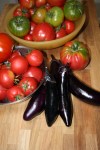
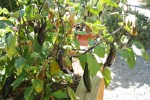
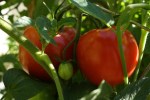
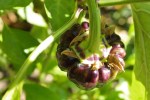
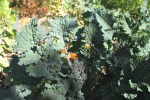
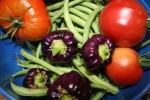
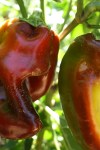
Beautiful things are coming out of the garden even this late in the season: the green, yellow, orange, red and purple of tomatoes, peppers, and eggplants. We have delicious beans, kale, and basil. And as much as I love just watching the plants grow, going into the garden and picking fresh fruits and veggies, I’ve started to think about how much of a difference a garden really makes in the bigger picture. If my family is still buying all of the tomatoes and peppers from farms we’ve never seen or known, does it matter if we’re growing food on top of that? Theoretically, we are having more meals from our own backyard so we probably buy less food from grocery stores, but that amount seems pretty small. I do prefer home-made pesto, bruschetta, and chili from home-grown ingredients to anything store-bought. But I still feel myself wanting a more significant change in our food purchases because of the garden. I am tired of seeing store-bought lettuce in the fridge when we have so much great kale in the garden. So, I’ve come up with a goal for next summer’s (and this winter’s) garden. as soon as the first of a given vegetable is ripe in the garden, I want to stop buying  any of that vegetable from the store up until the end of the season. I’ll probably have to start eating less of something for a while until there’s a lot available in the garden. But isn’t that what happens for anyone who actually lives off the food the grow? I look forward to trying it out, even if it proves a little tough.

Another idea I really like is tracking and keeping records of whatever we grow in our garden. We can write down what worked well, what we liked, a crop’s yield in a given week. I think it’s a really cool way to improve your garden from one year to the next, to have it grow and change as you try new plants but stick to the time-tested ones too. For example, I don’t think my family has ever had much luck with watermelons or pumpkins. We usually end up with just a few disappointing small fruits toward the end of the season. But I’m sure if we tried out different varieties and growing methods, we could figure out which type works best for us and how to care for it.

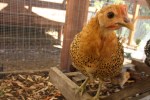
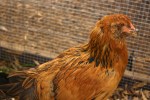
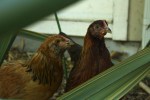
One of my favorite new things happening in my backyard is the relationship between the chickens and garden. Whatever tomatoes partially rot on the plant or lettuce gets a little eaten by bugs I can give to the chickens. One day I picked an apple and realized it had a few worm holes in it by some pest so I called the chickens over and offered it to them. They all gathered round and loved it. I’m so happy to think I’ve created a little cycle which gives the chickens a varied and delicious diet while getting rid of any waste from the garden. So far their favorites are apples, grapes, and tomatoes, but I’m always trying new things. Check out the pictures of the chickens and the garden above.

-Simon

King Corn

I heard about this documentary a while ago and just got around to watching it. (You can watch it on Hulu.) It follows two friends’ search to figure out why and how corn become such a giant part of our food system, such a common ingredient in foods at grocery stores. It’s hard to believe how ubiquitous corn is. In this movie, Michael Pollan tells us to consider a McDonald’s happy meal. What corn could there be in a burger, soda and fries? Surprisingly, there is almost a 100% chance that the beef was fed on a diet that consisted mainly of corn. The soda’s main ingredient and source of sweetness is high fructose corn syrup. The fries have probably been deep fried in corn oil. This is all the product of a massive increase in corn production over the last 30 years, after the government started promoting a “get big or get out” philosophy with commodity crops like corn. Across the country, people are planting more acres of corn, and producing more corn per acre. This corn isn’t even edible to humans before it’s processed into corn oil or high fructose corn syrup. We’re producing more corn than we know what to do with, so it ends up in giant granaries, its supply disproportional to demand. The government has to buy the corn from farmers and subsidize it to keep them in business. Farmers are motivated to increase their yield per acre, increasing supply and feeding this wasteful, costly cycle.

To investigate this phenomenon, friends Ian and Curtis buy an acre of farmland in Greene, Iowa. They grow their own corn crop, taking part in the process from planting to harvesting. On top of learning firsthand through farming, they talk to scientists, politicians, and local farmers. They try to trace their corn’s path to the supermarket. It proves impossible because they lose track of their individual harvest as soon as it is poured into the grain elevator, lost in a sea of Greene corn. In the end though, they learn about the system so that it becomes easy to predict the corn’s journey. It will go from farm to grain elevator through processors to become animal feed or high fructose corn syrup or corn oil. Ian and Curtis learn just how ridiculous this journey is.  The system sacrifices the health of American citizens, cattle, and the environment in its pursuit of economic stability. It’s not cheap in environmental costs nor is it sustainable. It’s hard to imagine how we could change a system with so much momentum and so many people behind it.

We want to counter this “get big or get out” philosophy. We need to give our support to farms that are built on sustainability, part of a more balanced system. Knowing that corn is in so many processed foods makes me want to eat fresh, whole foods even more. And as important as personal choice is, I think that this issue ultimately requires change within the government to be solved. The government is the force perpetuating the system, so the government must be the force to stop it. The more people that know about the issue, the more who will want to fight it and get things done. Our job is just to support what we think is right and spread the word until the controversy becomes so big that the government can’t ignore it.

-Simon

Permaculture

I remember the first time I heard about permaculture. I heard someone mention the word at Chewonki and asked them about it. Permaculture is hard to describe without providing a lot of details and examples, but its essentially a way of living and farming, of applying certain techniques and ideas in order to grow food in the most healthy, efficient, self-sustaining way. I’m talking about permaculture on here because I think it’s a great solution to a lot of the problems we face with food and energy shortages, but also because it is such a fascinating system with all sorts of unique techniques and ideas.

Permaculture or permanent agriculture is described by one of its creators, Bill Mollison, as “a philosophy of working with, rather than against nature; of protracted and thoughtful observation rather than premature and thoughtless labor; and of looking at plants and animals in all their functions, rather than treating any area as a single project system.”

Permaculture is built off three core ideas of taking care of the earth, taking care of people, and sharing. By keeping in mind what is needed by people, the earth, and all that lives here, we can figure out how to live in balance, taking what is necessary and giving extra to others and back to the earth. It is a holistic approach; the ideas overlap and work together. We need the earth and sustenance from it. We can help the earth get what it needs.

There are also 12 principles which govern the cycle of learning and improving the permaculture system. They include producing no waste, using biodiversity, and learning from nature’s patterns. More details and examples can be found here by clicking on the icons.

Permaculture is essentially the opposite of the wasteful, pesticide-ridden monoculture that produces most of our food. Instead of a flat field of homogenous corn, permaculture integrates several layers, learning from the efficiency of a natural system like a jungle. The layers, from the ground up, consist of cover crops (to reduce erosion), root crops, low herbaceous plants (the kind of annuals we have in gardens), woody shrubs (like berries), small and large trees, with vines crossing all of these layers vertically.

Other things that separate permaculture from more typical agriculture are its zones and patterns. The zones move out from a central house to the most frequently used and needy plants, main crops and orchards, through semi-wild areas for foraging and in the end an area kept completely wild. The plants may grow in a spiral pattern, from the top of a hill down with water trickling out to get the most of the resource.

Permaculture isn’t really plausible for most people without a huge commitment of time and money. That’s not to say we can’t learn from these principles or adopt some of them in our own houses, even if on a much smaller scale. Whether it’s composting chicken manure to cycle waste back into your garden or giving extra veggies to your neighbors, it’s a great approach to living in harmony with your surroundings.

Sources:

http://permacultureprinciples.com/index.php

http://www.holmgren.com.au/frameset.html?http://www.holmgren.com.au/html/Writings/weeds.html

http://www.shirleymaclaine.com/articles/environment/article-292

http://en.wikipedia.org/wiki/Permaculture

-Simon

CA Prop 37

In November, we will be voting on proposition 37, which would require the labeling of any products which contain GMOs. It would also not allow any products containing GE (genetically engineered) ingredients to be labelled as “Natural”. (Some background information and my opinions on GMOs can be found in an earlier post here: https://eat-for-the-earth.com/2012/04/07/gmos-29/.) The proposition is important because California is a very populous, powerful state. A law passed in California has a very strong chance of being passed in other states and nationally.

When I heard about this proposition I supported it immediately and wholly. I was wondering what a possible counter-argument could be. The proposition supports the simple idea that we have a right to know what is in our foods. Though it would be nice if it were that easy, the issue is of course more complicated. Those who oppose the proposition (companies like Monsanto and General Mills) have many points. They point out that the companies would have to spend a lot of money to repackage their products. However, many companies whose products can be found in the U.S. also sell to some of the 40 countries which require labeling for GMOs. Kellogg’s came up with a brand new package for the Olympics but they don’t want to do the same thing so the public can know what is in their product?

It is also said that the GMO label would possibly scare many people away, especially those who don’t know much about GMOs, and cause a massive drop in sales for companies whose products contain GMOs. Nothing could be worse than the public being afraid of the food in our stores without knowing about it. At the same time, maybe this will inspire the public to learn more about GMOs and what is in their food. They would be able to make more educated choices, even if it means supporting a company whose products contain GE ingredients. Products without GMOs would most likely continue to do okay. They would be required to start keeping records if their products are not labelled as Non-GMO or Organic. (Organic standards prohibit genetic engineering.) This could be initially costly. Even if many companies collapse, which I doubt will be the case, it may be beneficial in the long run, the kind of start we need to major change.

Another criticism is that the proposition includes many seemingly random exceptions to the labeling requirement, such as food sold in restaurants or meats: http://noprop37.com/uploads/1343839588-NoonProp37ArbitraryExemptions.pdf. Foreign food companies must only state that their food is “GE Free” to avoid putting the new label on but American companies and farmers must start to keep records to guarantee their products contain less than .5% GE ingredients by weight, starting 2014. Were the proposition to pass, this would be the strictest tolerance standard of any country. After 2019, the standard would go down to 0%. This scares me because it could mean the demise of many good-hearted companies that happen to have products contaminated by GMOs, which are so ubiquitous nowadays.

The proposition would bring a lot of change to grocery stores, food companies, what the public sees and knows about their food. There are some inconsistencies and I would no doubt change a few things were I to have written the proposition. For example, products from animals injected or fed with genetically engineered ingredients would not require the GMO label. But considering the proposition as a whole, I say yes, somewhat tentatively, until I have a chance to give it more thought. It seems to me the long run benefits would outweigh the initial troubles.

Here are my sources. I encourage you to learn more than I’ve said here.

http://giannini.ucop.edu/media/are-update/files/articles/V15N6_2.pdf

http://www.fogcityjournal.com/wordpress/4984/corporations-spending-millions-to-defeat-california-gmo-labeling-proposition/

http://www.sfgate.com/opinion/openforum/article/Prop-37-GE-labels-mean-higher-costs-3805499.php

http://www.huffingtonpost.com/2012/08/17/prop-37-california_n_1791555.html#slide=786553

http://www.noprop37.com/facts/

http://www.carighttoknow.org/facts

https://plus.google.com/u/1/+MikeElgan/posts/fXXtmS7TB7N

-Simon

How Change is Going to Come in the Food System

Here is an article by Michael Pollan off his site, which is worth checking out. http://michaelpollan.com/articles-archive/how-change-is-going-to-come-in-the-food-system/ Pollan has written numerous books on the food industry such as The Botany of Desire, In Defense of Food, The Omnivore’s Dilemna, and Food Rules. He is a journalist, but his books cover a large range from reporting to philosophizing. He is essentially the writer on the modern food system.

His article is practical and examines how problems will be solved, rather than the problems themselves. The article expresses one of my beliefs, that the sustainability of modern farming is in the end a matter of simple self-preservation. There are many people who have a deep connection with the land and see this as a reason to keep it healthy. But there are many more that don’t put any energy into forming this connection. I think the government, with its concern for economic and social issues, falls into this category. I don’t think there’s anything wrong with this prioritizing. People will find what is important to them and fight for it. The environment might not even be a factor in many decisions. But in the end, whether we feel a connection to it or not, we all rely on the environment for food, for livelihood. Whether it is important to you because of its beauty or because of the resources it can provide, the land and how we use it will define how long and how well we will live on this planet.

I realize I have zoomed out a lot from Pollan’s article. Coming back, we know that no matter how much we believe in this cause, the change we want will uproot an “entrenched power.” And as Pollan points out, we have to prove to these powerful people what they can stand to gain from change before anything will happen. We have to take a practical approach to our organization, making allies as we spread and showing people how it can benefit them personally. The best approach will be not only open-minded, but practical and interdisciplinary.

In the words of Prince Charles, “It is, I feel, our apparent reluctance to recognize the interrelated nature of the problems and therefore the solutions, that lies at the heart of our predicament and certainly on our ability to determine the future of food.”

-Simon