Category Archives: Everything

What Does Organic Really Mean?

I used to wonder about the meaning and significance of “organic” in both meats and plant products. I thought of organic products as more sustainable and low impact, but never knew what the word truly meant. It turns out “organic” doesn’t really have a simple, one line definition. It doesn’t allow certain processes like genetic engineering or radiation. It prohibits the use of most, but not all synthetic materials and pesticides, antibiotics, growth hormones, etc. The allowed exceptions include chlorine, soap, vitamins, disinfecting alcohol, vaccines that are produced from natural products and processes, and lots of other substances we’ve never heard of but are deemed harmless and nontoxic to the land, our health, etc. The list of exceptions is ridiculously long and complicated, citing other lists like “EPA 3- inerts of unknown toxicity.”The term “organic” also means the maintenance of soil health and water quality through a variety of methods such as crop rotation, which also serve to stop erosion, and manage pests. The certification requires consistent record keeping of “production, harvesting, and handling” for years prior to certification.2 This seems like a lot of really important regulation, but the definition of the word is really only part of the story.

The certification process is long and expensive, so there are a lot of farms out there that don’t have the resources to keep records and pay for the certification. The system then favors large-scale farms that are more standardized and have more workers. In this way, there could be many farms that don’t carry the organic seal, but easily meet or go beyond what is required for the label.  Another criticism of organic foods is that the certification is in the end just a list of requirements, methods, and prohibited substances. However, truly sustainable farming is the result of a holistic practice, beyond a quantifiable list. In the words of vegetable farmer Morse Pitts, “It’s just a list of things you can and can’t add to your crops. I take a whole approach to farming. It’s not some checklist I can tick off.”3 Truly sustainable farming takes into account the nature of a specific site and is constantly adjusting, improving. This is not to say that I don’t agree with a lot of the requirements of an organic label. But maybe a quantified label isn’t the answer.

The way organic works in the US is that the NOP (National Organic Program) is in charge of “overseeing the organic system in the United States” including “training, accrediting, and monitoring the independent third-party bodies that issue organic seals.”4 The most common example would be something like the USDA, whose seal we constantly see on products in the grocery store. There are about a hundred of these certifiers, all managed by the NOP staff which was at most eight people between 2002 and 2008.5 It’s easy to see that no matter how strict the regulations are, the enforcement is what makes the difference. The certifying bodies send inspectors to a given farm every year, yet these inspectors are only required to complete a “visual inspection” which leaves out soil samples or chemical tests. The inspectors often have a lot to do, may only see the fields from a distance, or not even visit the farm. Certifiers are often motivated more to keep their business with the farms they inspect than to be strict and honest. Fraud is not unheard of.6 And when the farm being certified is in another country and more organizations get involved, there is an even greater likelihood that the farm doesn’t truly live up to the specifications or what we think of when we read the word organic.

Outside of all this, there are 3 levels of organic in foods with multiple ingredients: “100% organic,” “organic,” and “contains organic ingredients.” 100% organic means just that; 100% of the ingredients are grown organically. Organic means that 95% of the ingredients by volume (excluding water and salt) are certified organic. A product labeled as containing organic ingredients must have 70% of its ingredients come from certified organic sources.7

And this is just the beginning of discovering everything behind the word “organic.” It is so complicated and there is still a lot more to learn. The way I see it, there are “organic” farms out there that are great or awful to their land and earth. There are farms without the organic seal that have a similar range. This only makes it more important to know the specific farm and develop specific opinions. If this is interesting to you, I recommend the book Green Gone Wrong by Heather Rogers. I got some of my data and quotations from this book. I’m not finished with the book but I’ve learned a lot so far and I’ll definitely write about it on here once I’m done. For the sake of honesty and acknowledgement, I’m going to start citing my sources for specific facts in informal footnotes.

1 2 National Organic Program Electronic Code of Federal Regulations http://ecfr.gpoaccess.gov/cgi/t/text/text-idx?c=ecfr;sid=dd55fb5a1230b3dde926629bf8e6a50c;rgn=div5;view=text;node=7%3A3.1.1.9.32;idno=7;cc=ecfr

3 4 5 6 Green Gone Wrong by Heather Rogers

7 The Daily Greenhttp://www.thedailygreen.com/going-green/3979

-Simon
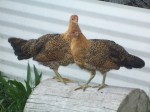
New Chicks

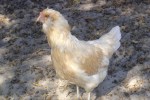
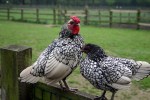
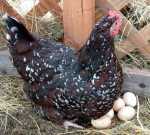
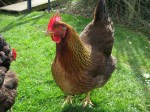
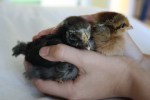
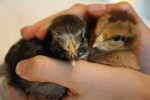
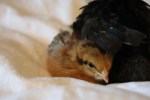
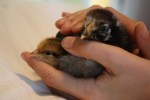
Here are some pictures of the chicks we just got from a place called Mill Valley Chickens which raises different breeds for people who want to keep chickens. We got 5 different breeds: Ameraucana, Speckled Sussex, Silver Laced Wyandotte, Welsummer, and Sicilian Buttercup. Below the pictures of the chicks, I have included what these beautiful breeds will look like full-grown. Each breed has a different mood, appearance, and lays different eggs. We are expecting a mix of light blue eggs, white eggs, light brown eggs, and dark brown speckled eggs.

I was inspired by the farm at Chewonki to get chickens and I convinced my parents to let us get them as a birthday present. The biggest reason was that I wanted to stop buying eggs from the store by relying completely on eggs which I had helped produce. I know exactly how these birds are treated, what they are fed, and what goes into raising them.The chicks are only a week old, but I imagine it will be the same kind of joy that comes from growing your own food in your garden: checking up, giving them what they need to grow, and then waiting for your amazing, satisfying product. Chickens  make such good pets that the product is definitely only a part of the process.

It makes me happy that chickens are becoming more and more popular. It makes so much sense to me. I’ve always debated the rightness of keeping a pet. I know that in the end I am supporting the artificial breeding of animals for traits that are desirable to humans. It seems kind of selfish. And it’s no different with chickens, except here they serve the important purpose of feeding us. To me, that makes it worth it. We aren’t going to stop chickens from being bred and crossed, but we can give all that history its original purpose back by bringing it all home. Even if it means taking another animal’s eggs, we are participating in our food system rather than sitting to the side and watching it happen (or most of the time, not even watching).

If it is possible in your house, I highly recommend getting chickens. I know many people who keep chickens and say that it is easy and cheap. That is a practical reason. But if you want to get involved in the production of your own food and take joy from raising an animal to produce that food for you, that is an important, moral, personal reason. If you are interested in getting chickens and have any questions, feel free to ask and there is also a great site http://www.backyardchickens.com/ where you can find things out. I do also suggest you look up the laws on keeping chickens in your city.


Here is a project going on in New York to bring these ideas to people living in the city. http://handpickednation.com/watch/the-city-chicken-project/ I think these are the kinds of projects, that if executed practically and with the public in mind could help normal people across America. -Simon

Wasted Food

A subscriber showed me this article and I wanted to share it with everyone. http://www.cnn.com/2012/06/27/world/europe/food-waste-emissions-pichler/index.html I find the pictures gorgeous especially considering what they portray. At first, I didn’t really know what was being photographed. And then I realized all the exotic and alluring shapes and textures were spoiled food. The pictures almost look like advertisements, this “high-end, fashion magazine finish” reflecting the “‘over-commoditization’ of food as a lifestyle accessory.” So then, the solution to this over=commoditization is to stop thinking of food as a cheap commodity. What if food was a valuable investment? What if we could think about all the work and energy that went into a product when we bought it, rather than just which is cheaper? We need to value food more and take the extra effort to avoid throwing away unnecessarily.

For the last few days after I told my mom the shocking 1/3 statistic, we were both noticeably more aware of what we were throwing away. We just need to bring this awareness to every day. It’s such a simple, direct way to stop the wasting of energy and decrease carbon emissions. What if, at the end of every month, we stopped ourselves from buying new food and forced ourselves to finish off leftovers, be resourceful, and use the food we already have? And when we do buy food, we should buy from stores and brands that we think are the least wasteful. As the article points out, it is in the end a cultural issue and our culture is defined by us, so our choices around food are truly the biggest thing we can do to redefine the culture when we find it wasteful and harmful. It goes past carbon emissions and science and is truly about how we view food.

At Chewonki I discovered the fast as a way to grow my appreciation of food and further my understanding of how it affects me. While on my solo, when I spend a few days in the woods, I chose to fast. I’ve done a few one day fasts since then and plan on a three day fast this weekend. It’s remarkable and inexplicable what I’ve found out about food and it’s value. It’s definitely a “you dont know what you’ve got til it’s gone” phenomenon. Along with the numerous health benefits which you can read about here http://mushpanjwani.com/2009/08/23/11-health-benefits-of-fasting/,  it is a personal, spiritual, new look at food.

-Simon

EWG Report: Assessment of Different Foods’ Life Cycles and Carbon Emissions

This thorough report by the Environmental Working Group looks at a range of foods’ carbon emissions across different stages of their lifecycle, from production to disposal http://www.ewg.org/meateatersguide/a-meat-eaters-guide-to-climate-change-health-what-you-eat-matters/ I really value the information presented in this report because of its approach. It isn’t raw numbers; it’s all comparative and evaluative. It’s holistic and takes into account every part of the process, detailing how every step contributes to the over-all environmental impact of a food. The pie charts and bar graphs give simple visuals, but there are also in-depth explanations. The study brings to light that just wasting food contributes a large percentage of emissions to a food’s total. It has always made sense to me to eat everything that you take and I think it is part of valuing and enjoying a food to its fullest. Food has to mean something to us. It is not something to just throw away. And now I know there is scientific evidence to back that up, as this contributes to the large percentage of a food’s emission that comes from avoidable waste. The report also backs up that composting can help reduce carbon emissions; less food waste going into land fills, more going back into the garden. It is therefore not only important what food you buy, but what you do with the product after you buy it: how much you’ll eat, how you will dispose of it, etc.

The page on nutrition speaks to me because I am always trying to convince people they can get more than enough protein without meat, as well as plenty of other nutrients. You don’t need to look far to see the health benefits of cutting down meat intake. And if there is a meat you’re going to cut down on, I think the study makes it clear that ruminants are the worst polluters and red meat the worst for your health. At the same time, pasture-raised and organic beef seems like a good alternative. And while decreased inputs and no chemicals or antibiotics makes for a less harmful practice, I think that beef farming inherently involves a big environmental impact, as is true with pretty much all agriculture on a larger scale. It really depends on the place and I think this study is very strong in it’s specificity and lack of generalizations. Organic might mean a lot in certain cases, and nothing in others, which is what I’ll talk about next post.

-Simon

Foraging

This article from the San Francisco talks about something I’d never really thought about seriously before. http://www.sfgate.com/cgi-bin/article.cgi?f=/c/a/2012/06/08/HO891O5F30.DTL I’m sure we’ve all done something like pick a few wild blackberries or some sour grass, but foraging has become a reliable food source for some people. I remember at the farmer’s market last week, there was a stand where I filled up a big bag with all different greens in baskets. In one basket was an eclectic group of little beavertail cactus leaves and fuzzy blue-purple flowers. I asked about the flowers and the farmer said they were wild borage and that they tasted like cucumber. I put a few in my bag to try and they were delicious. It didn’t really register with me, but the borage was the first foraged food I’ve bought. It’s kind of cool to think that it was just a weed and was used for food.

Considering the sustainability of foraging as it becomes more popular, I think the keys are balance and just knowing what you’re doing (as with pretty much anything). I don’t think you should kill the plant if you’re only going to eat some of the leaves. But maybe the plant is invasive, and should be pulled up. Maybe it will regrow if you only pick the oldest leaves. Maybe it’s a really important native plant and you have to come back once its older or wait for it to be pollinated and start a new generation of plants. I think it really depends on the plant. The possibilities seem amazing to me. What if there is a ubiquitous invasive plant that can be harvested for food? It seems like a pretty solid way to kill two birds with one stone.

On a similar note, I was reading the caption of the picture in the article and started to research natural dyes. There are lots of common backyard plants that can be used for dying. I used a few poppy roots to dye some yarn a light yellow the other day. I know onion skins can make a yellow-green to orange color. I think it’s a really cool way to use every part of the product. I’m saving my onion skins in a bag until i get enough to dye some fiber or a shirt. Sourgrass, that clover with yellow flowers that grows everywhere, can be used for a yellow color. It’s amazing to me how many plants out there have a useful purpose we don’t know about, whether its for dying or eating.

-Simon

P.S. I’ll be putting up a new page soon with recommended books and movies, about the food industry or agriculture. On top of that, keep checking the sites page, because I’m always adding new sites.

Is Local Food Really the Best Choice?

I’ve been working on this post for a while. I hope it has some new information and thoughts. I have a lot to say and the post is pretty long, but there are still things I couldn’t fit in. So ask about something if you’re looking for more. Also, I still have a lot to learn about food, so I may be leaving things out and saying things that aren’t supported by a lot of information. A lot of this is just thought.

It’s easy to think a product that’s grown 50 miles from me in my own state automatically makes more sense than something grown a few thousand miles away in a different country, or even continent. However, there are people who would disagree with me and they present many valid and powerful counter-arguments. Here is an example of some of these ideas presented in two articles. http://www.foreignpolicy.com/articles/2011/09/12got_cheap_milk / Local food is mentioned only briefly here. There are really insightful comments if you scroll down and be sure not to miss the second page of the article. http://www.freakonomics.com/2011/11/14/the-inefficiency-of-local-food/ and a video to go along with it http://www.dailymotion.com/video/xqcfip_freakonomics-does-eating-local-hurt-the-environment_lifestyle I’ll try to summarize what I think are the key arguments in these articles and present my thoughts.

Certain foods grown best in only a few places. If everyone tries to grow these “locally,” there are a lot of unnecessary inputs and energy that wouldn’t be needed if they were grown in climates where they naturally fit. The example of eating local lamb in England shows that just because something is from closer to home, does not mean that it’s better for the environment or more sustainable. I don’t think any of us want to support something that’s sucking up extra energy, even if it is local. Here in California we are lucky to have a temperate climate that supports a huge range of crops. While at Chewonki, I heard of someone growing tomatoes hydroponically (in water, without soil) in a greenhouse in the middle of a Maine winter. That product is local, but it may be using more water and energy than I want to support. This is where knowing the plants which grow well in your region and season is important.

The second article reveals some economic inefficiencies of a localized food system. It points out some economic weaknesses of localized agriculture to go along with the idea that certain plants grow best in certain places, each area specializing in a number of crops. I think this part of the article over-simplifies things. There can still be specialization to some extent. I am willing to support something that comes from a little farther, maybe a few hundred miles, if I know it is grown well. I just think small-scale, shorter distance trade makes sense here. This is still a valid point and a weakness in hard-lined locavorism.The article points out that a change to a localized food system would not only damage trade, but  would also require more inputs and more land. That the change would be expensive and drastic is indisputable, but what if the new localized crops are replacing large, conventional farms? And the idea that a localized food system would use more pesticides doesn’t apply if the food is grown unconventionally and without chemical inputs. Obviously, I can’t discount the entire study cited in this article and I believe that it is valid research. It points out another hole in the local food argument. But I also believe there are a variety of different farming techniques that could help smooth the land-use change. 

Localized, small-scale farms could also be seen as less efficient than larger scale operations. But the pollution of these farms  is nothing compared to larger ones. This can’t be ignored because pollution actually makes these farms less economically efficient if we look at natural capital (http://en.wikipedia.org/wiki/Natural_capital). In other words, are large farms really more efficient if they are causing long term damage to the land and environment that will cost a lot of money in the long run? If we think about the future, small farms are more economically sensible and sustainable in their impacts on the environment. In my mind, a large and concentrated food system isn’t the answer, and I am okay with stopping those trends mentioned in the article if it means each community is more self-sustaining.

However, it’s still true that small-scale, localized farming is probably using more inputs per output, making the healthiest foods more expensive. But as the first article mentions, organic farms can be as or more efficient as larger conventional ones. The trick is getting all of the farming methods down so that we can get to that peak efficiency. In a book I’m reading called Green Gone Wrong (which will definitely appear in a later post), a farmer talks about growing foods by trial and error and discovering things he never would have known by just trying things out. Through trial and error, small-scale localized farming can become super efficient and adopted well in each area according to that area’s climate. Maybe it doesn’t make sense for someone in Maine to be growing oranges so they’ll have to get them from Florida. We can keep orange prices steady  by not forcing them into environments where they won’t do well or will require more inputs. As for decreasing prices in grain and unhealthy products like corn syrup, I think localized agriculture can actually help solve this. If each region sticks a little bit more to specialty crops so that corn and soy aren’t being grown absolutely everywhere, we can have a more proportional food production of fruits, veggies, and grains. Besides, grains are a filling dietary need and are a great option for poorer people if corn and wheat stay cheap. It’s not bad to have something cheap and grown across different regions as long as it doesn’t get ridiculous. I’m talking about a point when we have to find products to put the crop into in order to keep prices from going down as supply skyrockets (e.g. corn).

In response to the end of the second article and borrowing from a comment on the first one, people in developed countries eating locally grown food is not the reason that people in developing countries don’t have food. Often, these people used to grow a variety of subsistence crops from which they could feed their family. But a demand for a cash crop like rice (as is true with India) may have forced these farmers to switch to growing a single product. If we support these products, then we are in fact contributing to a lifestyle that is hurting the world’s poor. So, it seems that the answer would necessitate these farmers going back to the range of crops they have traditionally grown to achieve true self-sufficiency, needing only themselves or their neighbors for food. This is in fact localized agriculture. But how can we support this type of a food system in another country? This is a very complicated question that I’ll attempt to answer in another post (not that it has a definite answer).

In the end, it’s not like I can create a “big picture” from all this information, though I always wish I could give a simple rule. I guess it’s just important to note that eating local is not a cure-all. There are lots of complications involved with the kinds of farms we want to support and I think the importance of the second article is to think about the future of our food system. Complete localism throughout the country certainly seems idealistic and possibly very harmful to the economy. But I think a balance of localized and some larger scale agriculture could possibly work out.

In the independent research project I did for my Environmental Issues class, I talk about how it may be important and necessary to support products that are grown very far away from us. I’ll talk about this in a later post.

Milk

Sorry I haven’t posted for a long time. I just got back from Chewonki and I definitely have a lot to share about the things I learned there.

While at Chewonki, I took on a vegan diet except I drank milk from my friend’s farm. It is part of my philosophy to not only avoid foods which are harmful to the environment, but support those that I deem sustainable and kind to animals. Milk grown on the local Goranson farm fell under the last category for me. The milk is special because it is super fresh and I know the person who is making it. The mik comes from just one cow, which means Carl (my friend’s brother) can give that cow a lot of attention and care, making sure to keep her happy and healthy. The coolest thing about this milk is that it’s raw, unpasteurized and unhomogenized. Homogenization just means that the fat globules in the milk are brought under high pressure to mix them into the rest of the milk and create a homogenous solution which looks clean and fresh to consumers. All milk that is sold at supermarkets is pasteurized, meaning it’s heated to kill any bacteria and make the milk effectively sterile. But the heating gets rid of a lot of other things that are beneficial for humans. It reduces the amount of vitamins A, B, D, E, and K. It denatures the enzyme lactase which helps us digest the protein lactose in milk. It kills helpful bacteria which would naturally fight off the bad bacteria like E. coli or Salmonella. A lot of milk in supermarkets is vitamin D fortified and Lactaid is milk that has the lactase enzyme added back into it. These fortifications are examples of humans destroying something that is naturally present in the milk only to add it back in, which seems pretty inefficient to me. The reason we have pasteurization is to get rid of pathogens and harmful bacteria, but these wouldn’t be present if we had better, cleaner conditions for our cows. If pasteurized milk is safe because it is sterile, raw milk is healthy because it is rich in life. I am lactose intolerant and I hadn’t drunk milk in probably 3 years, but I tried that raw milk with no problems.

The pasteurization process makes sense for a system which is looking for efficient, guaranteed, standardized safety. I think it’s nice to hear the other side once in a while, though. Pasteurization makes sense for our current system, which transports milk long distances. Here is a really cool site which allows you to figure out where your milk came from by looking at a code on the bottle: http://whereismymilkfrom.com/ This isn’t the kind of system I want to support, which is why I won’t drink milk. The kind of self-sustaining, localized agriculture like Carl’s makes sense for me. Since raw milk can’t be bought in a grocery store, I won’t likely drink milk again. There are a few reasons for this decision. Often times, I hear the argument that cows enjoy being milked. This is true if the cow is giving milk to its calf or being milked gently by hand. But with commercial milk production, cows are milked by machines which aren’t comfortable or careful. Along with this mechanization, cows must be repeatedly impregnated to keep them producing milk. If the cow gives birth to a male cow, it will likely be sold to become veal and live a short life in a confined crate. Whenever I think of consuming milk, I remind myself that I am in a way indirectly supporting the veal industry and other cruel practices.

Obviously, it’s a really hard change to fundamentally change what you consume, but I find it fascinating and enlightening that a product we often don’t think about has so many moral and environmental complications to it.

-Simon

The Pleasures of Eating

Last week for farm talk I read a few essays by Wendell Berry, a great farmer, writer, and thinker. Here is a quote from Berry that I really like, relevant to everyday life as well as agriculture: “In order to have leisure and pleasure, we have mechanized and automated and computerized our work. But what does this do but divide us ever more from our work and products–and, in the process, from one another and the world? What have farmers done when they have mechanized and computerized their farms? They have removed themselves and their pleasure from their work.” Therefore, I think we can ask ourselves: did the farmer take pleasure in his work of caring for the things he grows? Was he close to his “work and products”? Could the things living on his farm take pleasure in their lives? And if we can know that the answer is yes to these questions, it is probably a food we can take informed pleasure in eating. Below is a really cool essay I read for farm talk last week. I like what Berry has to say about being an active consumer rather than a passive one as well as what it means to truly be able to take pleasure in eating. Here is The Pleasures of Eating by Wendell Berry (1989): http://www.ecoliteracy.org/essays/pleasures-eating

GMOs

This past week in my Environmental Issues class, we discussed and debated about GMOs (genetically modified organisms). The majority of GMO crops today are commodity crops such as corn and soy. A very large majority of these crops grown today, I think 80%, are genetically modified.

Currently used GMOs include Bt corn and Roundup Ready soy. Bt corn was created by transplanting genes from the bacterium Bacillus thuringiensis (Bt) which lives in the soil and creates a toxin that can kill corn borers, a common pest for corn plants. The genes which code for the formation of this toxin were implanted into the corn to create a plant that essentially grows its own pesticide. Roundup Ready soy has been modified to resist the broad-spectrum herbicide Roundup. This means that farmers with Roundup Ready crops (the gene has been used in many other plants like cotton and sugarbeets) can spray tons of Roundup on their crops and kill everything green but their soy. Higher yield and drought-tolerant plants provide a potential for increased productivity with less resources and energy needed, however the predominance of Roundup Ready crops means that even more pesticides are being sprayed on crops nowadays with the appearance of GMOs.

There are many pros and cons of growing GMOs and for a while it was hard for me to decide if I agreed with the implementation of GMOs in our food system. It is largely a theoretical issue because the technology has only been around for a few decades and there are many long-term still to be seen. Also, there are many potential benefits and ideas for crops that have yet to be fully developed.

After a lot of thought, I have come to disagree with the idea of having GMOs in our food sources. I am not against the idea of genetically modifying organisms and I can definitely see the potential. Modifying plants to be more heat-tolerant, drought-tolerant, salt-tolerant can help us to produce food for a growing world. These plants even offer a possibility for those in poor and developing countries to get a steady source of income. They have the ability to survive many conditions and even restore damaged land. Many crops can give higher yield and productivity, another plus for those using agriculture to start developing a community and searching for economic stability.

The reason I object to GMOs is the way that they are currently integrated into agriculture. A court case decided that it is now legal to patent a certain set of genes, known as the “patent on life.” This decision means that a seed producing company like Monsanto can own a certain genetically modified crop seed and sue anyone found with that seed who didn’t pay for it. The monopolization is harmful to a small farmer’s way of life as Monsanto will often sue anyone who has had GM seeds blow onto their property and accidentally saved them. This also means no saving seeds if they are genetically modified, because Monsanto owns the seed and reproduction of the seed would be infringing on their patent. This is one of the issues I take with GMOs. The concept of buying new seed does not allow for the kind of sustainable cycle necessary for a farmer to be in harmony with nature.

Thinking back to the TED talk I shared earlier about fish, I think that the most sustainable and productive farms are the ones who work with the systems of nature, not against them. The idea of GM crops is scary because it may lead to a future of low biodiversity, potential pesticide resistance as well as a high possibility of contamination of the environment with super-seeds which could take over. If we want a truly reliable future for our food system, the best possibilities lie in farms like the fish farm in Spain from the TED talk (here), which don’t interfere with nature. GMOs may be cheaper economically given their higher yield, but they are not cheaper in the resources they use or the farms they put out of business.

Even the promise of helping developing economies is tainted by the monopolization of GMOs. When Monsanto helps communities by giving them seed to buy, they are often in it for the money and may end up exploiting the community. The adoption of GM crops can result in an Americanization and loss of culture for these countries. Many countries have cultural ties to the very crops they grow and won’t want to adopt new ones.

GMOs have promise outside of our food, though. Certain plants have been genetically modified to be able to absorb toxic substances such as TNT and convert them into less toxic ones, known as phytoremediation. I think that these plants  can no doubt help with clean up after wars or chemical spills, but the patent on life has no place in our food system. It harms small farms and grows monopolies. GMOs as they are currently implemented cause the use of more pesticides and breed the kind of farming that is low in economic cost, but high in environmental cost.

Though GM crops allow us to plant more in new places, I don’t think this is the answer to food shortages and I don’t think it is breeds a sustainable way of farming. GMOs as they are currently produced expand the kind of industrial agriculture that will cause problems with energy and resources, not solve them. I think it is impossible to integrate GMOs into the kind of independent, low-impact farms which will help get everyone food without damaging the environment.

Link

Food Cycle

This Friday, two former Chewonki staff gave a presentation on their project, Food Cycle. Part of the presentation was a group of images showing a typical lunch for kids at public elementary schools in different countries. We saw meals from Asia, South America, and Europe. In each instance, the meals were cultural and balanced, healthy and with whole foods. We could see that most contained local ingredients; they seemed fresh, simple, and put together with care. When we came to America, the foods were extremely processed and the meal unbalanced: mostly meat, dairy, and carbohydrates. Where Japanese students ate miso soup, rice, veggies, and tea, the Americans had a corndog, mac and cheese, and whole milk. Adam and Leah started Food Cycle to change this trend. One of their ideas is that our education about food starts when we’re children choosing what to eat in the lunch line. In a state like Maine where lots of local farms make fresh, sustainable food a lunch option, kids should be learning what is good for their health and the earth at a young age. Another thing that they brought up was the government involvement in the current food available at public schools. They stated that the money needed to supply public schools with whole, family-farmed food is no more than that which the government currently spends on over-processed, industrially-farmed food. Through Food Cycle, Leah, Adam, and their team aim to connect farms with schools so that each benefit. They plan to bike across America and with sponsorship, start by donating a program to bring farm-fresh food to Harriet Beecher Stowe Elementary school in Brunswick, Maine. “Cycling approximately 4,500 miles from Maine to California, riders will stop at small-scale organic farms and public schools along [their] route, documenting the emergent farm-to-school movement and other programs dedicated to school nutrition reform.” Read more  about their ride at http://foodcycleus.com/?page_id=183 and their mission at http://foodcycleus.com/?page_id=89.